Best Permanent Jewelry Welder for Beginners in 2026: Machines, Kits, Costs, and Buying Tips
Choosing the right permanent jewelry welder can decide whether your first pop-up feels professional or expensive and chaotic. This guide breaks down beginner-friendly welders, starter kits, pulse arc vs. laser machines, price ranges, safety gear, and the buying mistakes to avoid before you spend money.
 Click to view full size
A permanent jewelry welder is not just another tool purchase. It is the center of the service. If the welder is underpowered, hard to control, unsafe, or too clumsy for mobile events, the whole business feels amateur. If the welder matches your first 90 days, you can practice faster, serve customers with more confidence, and avoid wasting money on equipment you do not need yet.
The strongest beginner path is usually a pulse arc permanent jewelry welder, not a full studio laser system. Pulse arc welders are portable, easier to set up at pop-ups, and more realistic for bracelets, anklets, fine chain, and small jump rings. Laser welders can be excellent for advanced jewelry repair, but they are usually overkill for a beginner permanent jewelry business.
What Is the Best Permanent Jewelry Welder for Beginners?
The best permanent jewelry welder for most beginners is a compact pulse arc welder made specifically for permanent jewelry, with controlled energy settings, a safe stylus setup, argon compatibility, reliable eye protection, and support from a known supplier.
For a tight starter budget, a beginner-focused machine like the Sunstone Zapp can make sense. For more control and room to grow, a 1–30J or 3–30J pulse arc welder such as Zapp Plus, Orion mPulse, or a similar professional permanent jewelry welder is usually the stronger long-term move.
What Is a Permanent Jewelry Welder?
A permanent jewelry welder is a small precision welding machine used to close a jump ring or chain link so a bracelet, anklet, necklace, or charm sits on the customer without a traditional clasp. The jewelry is still removable with cutters, but the look is seamless and fitted.
Most beginner permanent jewelry artists use a pulse arc welder. It creates a tiny controlled arc at the connection point. The goal is not to melt a large area. The goal is a clean, focused weld that closes the link without damaging delicate chain, burning the customer, or leaving an ugly join.
Best Permanent Jewelry Welders for Beginners in 2026
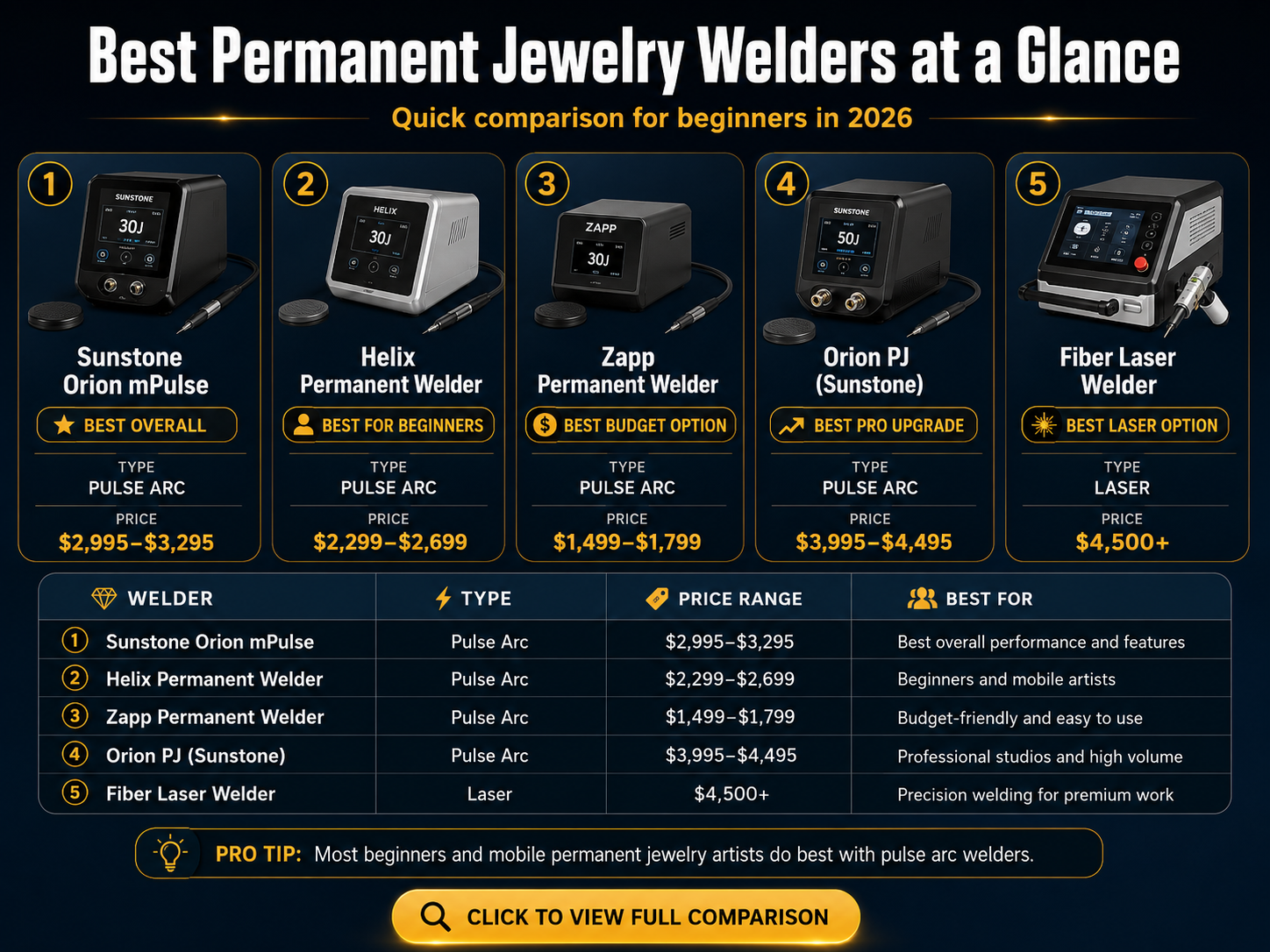
The right machine depends on budget, event style, and how fast you expect to grow. Below are practical categories to compare before buying.
 Click to view full size
Sunstone Zapp — Best Low-Cost Beginner Pick
The Zapp is built for beginner permanent jewelry artists who want a real permanent jewelry machine without jumping straight into a higher-priced professional setup. It is designed around simple energy control and permanent jewelry use, not general repair work.
- Best for: first-time pop-up artists testing demand
- Watch out for: less power and less control than higher-tier machines
- Smart move: buy only if the lower energy range fits your chain and jump ring plans
Zapp Plus — Best Upgrade for Beginners Who Want Room to Grow
Zapp Plus is the more flexible beginner upgrade because it adds a wider energy range and improved stylus setup. This matters if you plan to offer more chain styles, anklets, and a better event experience as the business grows.
- Best for: serious beginners who do not want to outgrow the machine quickly
- Watch out for: higher upfront cost than the basic Zapp
- Smart move: choose this tier if you already have event leads or a clear launch plan
Sunstone Orion mPulse — Best Overall Permanent Jewelry Welder
The Orion mPulse is a popular professional-style pulse arc option for permanent jewelry because it combines portability, a broad energy range, and a setup designed for fine chain work. It costs more, but it gives serious artists more room to scale.
- Best for: committed artists, mobile businesses, and pop-up brands
- Watch out for: buying it too early before you validate demand
- Smart move: choose it if permanent jewelry is a real business plan, not a random experiment
Pepetools Helix — Best for Starter Kit Buyers
The Helix permanent jewelry welder is worth comparing if you want a kit ecosystem, training-friendly setup, and a supplier that sells permanent jewelry accessories around the machine. It can make sense for buyers who want more of a packaged launch.
- Best for: buyers who want welder + kit support
- Watch out for: comparing the full kit price against machine-only pricing
- Smart move: check exactly what comes in the bundle before comparing price
Professional Studio Welders — Best for Advanced Shops
Higher-end welders and laser systems can be excellent for jewelry repair shops and advanced studios, but they are rarely the first move for a beginner side hustle. If the machine costs more than your first few months of expected bookings, slow down.
- Best for: established jewelry studios and advanced operators
- Watch out for: overbuying before you have customers
- Smart move: upgrade when bookings, chain variety, and workflow demand it
Permanent Jewelry Welder Comparison Table
Use this table as a starting point, then check the current product page before purchasing. Prices, bundles, warranties, and included accessories can change.
| Welder type | Best for | Typical price range | Learning curve | Beginner verdict |
|---|---|---|---|---|
| Sunstone Zapp | Budget beginners testing the business | About $1,099+ | Easy | Good first machine if budget is tight |
| Zapp Plus | Beginners who want more control | About $1,395–$1,699+ | Easy to moderate | Strong upgrade pick |
| Orion mPulse | Serious mobile and event-based artists | About $2,400–$3,000+ | Easy to moderate | Best overall if budget allows |
| Pepetools Helix | Kit buyers and training-focused starters | Varies by bundle | Easy to moderate | Compare bundle value carefully |
| Laser / advanced studio welder | Jewelry repair shops and advanced studios | $4,500+ often | Moderate to advanced | Usually not needed first |
Pulse Arc vs. Laser: Which Welder Is Better for Permanent Jewelry?
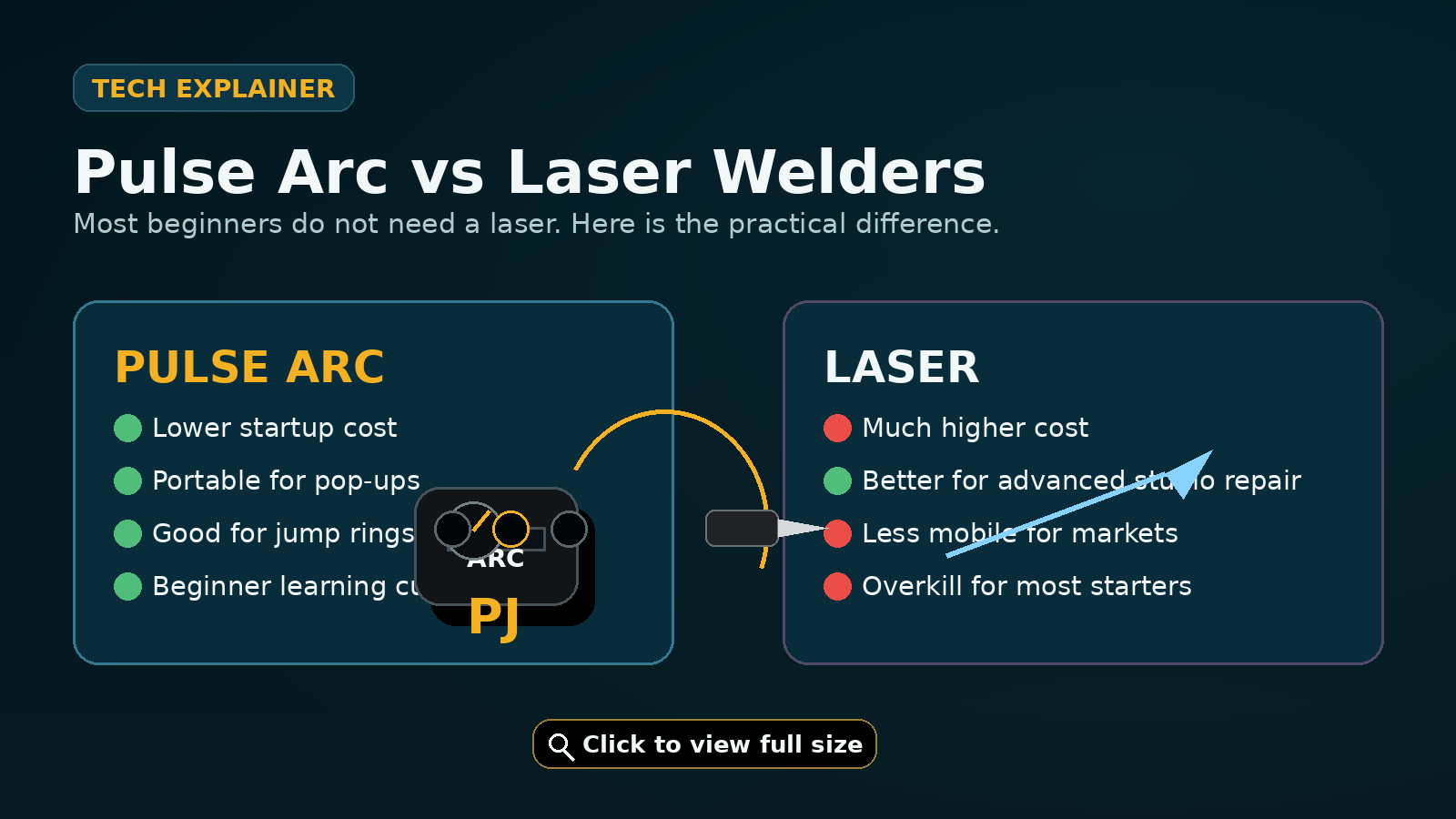
For most beginners, pulse arc is the practical winner. It is smaller, more portable, less expensive than laser systems, and built for the tiny welds used in permanent jewelry. Laser welders can produce precise results, but they are normally a studio-level investment and can create unnecessary complexity for a beginner mobile business.
 Click to view full size
What to Look for in a Permanent Jewelry Welder
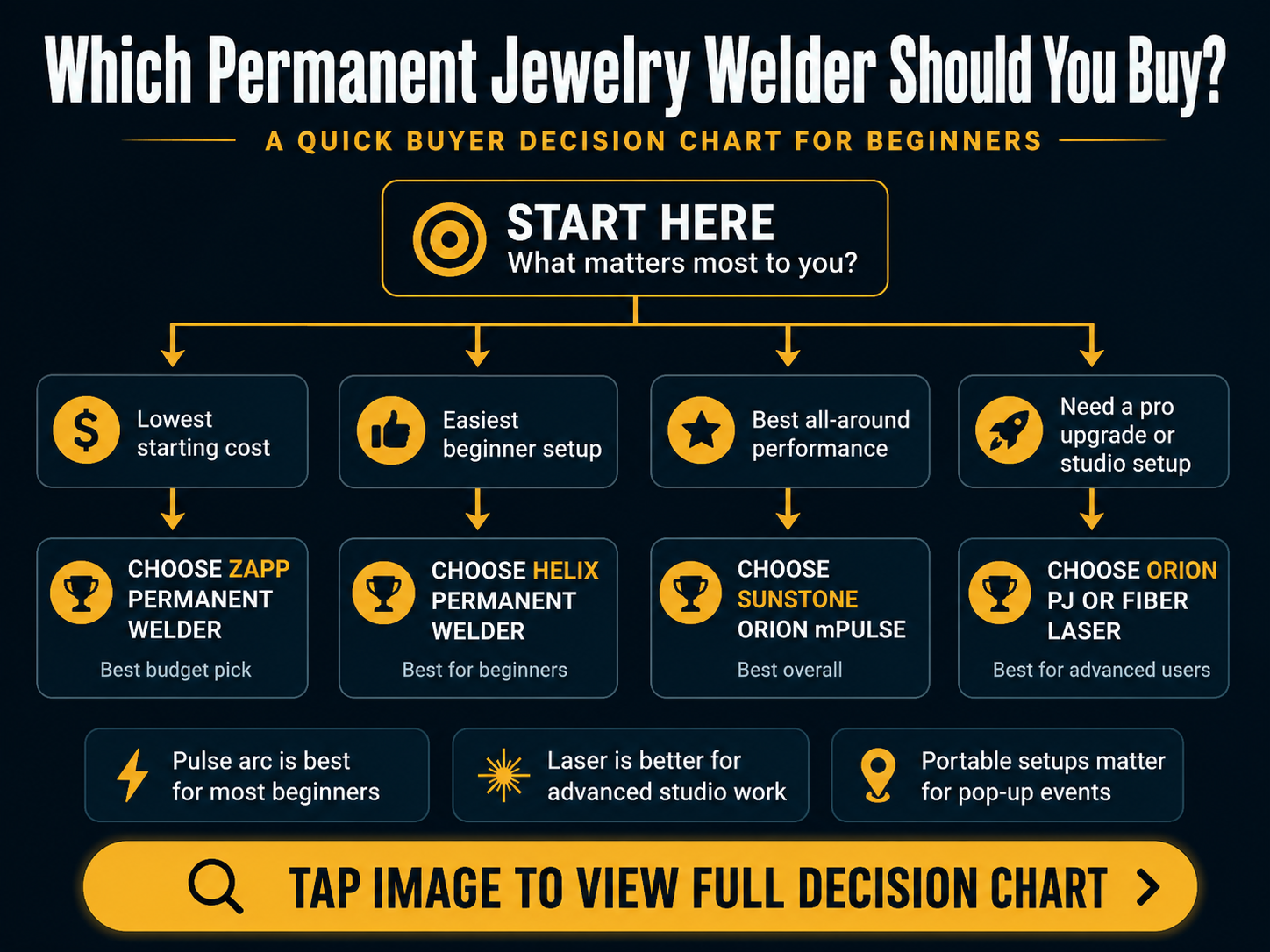
Most bad purchases happen because the buyer focuses only on price. Price matters, but it is not the full decision. A cheap permanent jewelry welder is expensive if it produces inconsistent welds, scares customers, has no support, or cannot handle your event setup.
 Click to view full size
Permanent Jewelry Welder Kit: What Should Be Included?
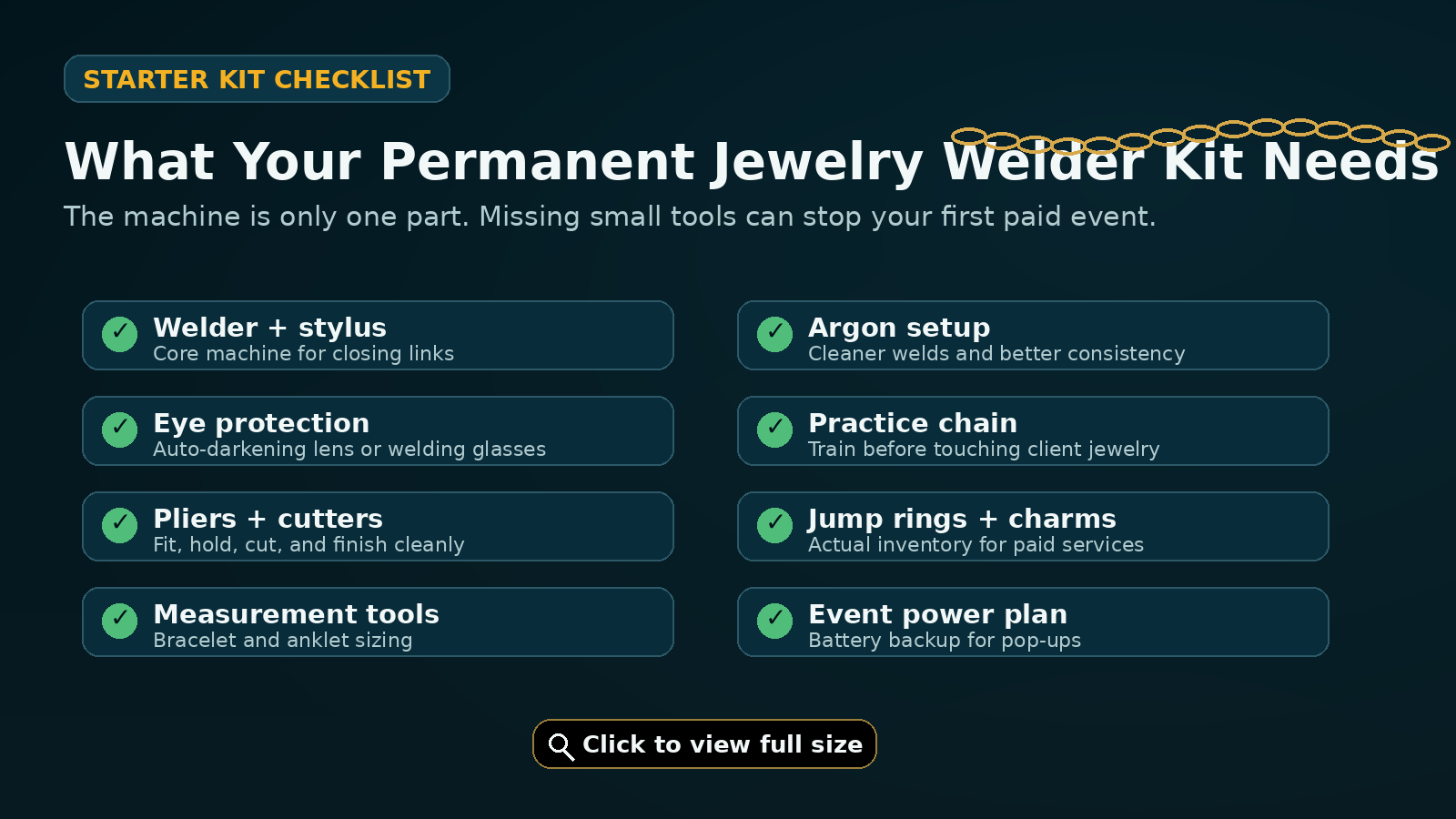
A permanent jewelry welding kit should include more than the machine. Beginners often forget the small pieces that make the service possible: eye protection, chain cutters, practice chain, jump rings, pliers, measurement tools, electrodes, argon accessories, and a way to organize supplies at events.
 Click to view full size
| Kit item | Why it matters | Beginner mistake |
|---|---|---|
| Welder and stylus | Creates the actual weld at the jump ring or chain link | Buying a generic machine with poor control |
| Eye protection | Protects the operator during the arc | Using the machine without proper lens or glasses |
| Argon setup | Helps improve weld cleanliness and consistency | Ignoring gas setup until results look messy |
| Practice chain | Lets you train before touching paid customer jewelry | Practicing on expensive inventory too early |
| Pliers and cutters | Needed for sizing, holding, and finishing | Using poor tools that damage delicate chain |
| Electrodes | Consumable part that affects consistency | Not buying replacements or learning sharpening basics |
| Storage and display | Makes your pop-up look professional | Showing up with supplies scattered in random bags |
How Much Does a Permanent Jewelry Welder Cost?
A beginner permanent jewelry welder can start around the low four figures, while stronger professional pulse arc machines can move into the $2,000–$3,000+ range. Advanced laser or studio machines can cost much more. The machine is only part of the startup cost; you also need chain, jump rings, charms, event display, tools, safety supplies, and practice materials.
Do not build your budget around the cheapest machine only. Build it around your first launch. A better question is: What setup lets me safely practice, book my first event, and deliver clean welds without looking unprepared?
Should You Buy a Used Permanent Jewelry Welder?
A used permanent jewelry welder can save money, but beginners need to be careful. You may not know how heavily the machine was used, whether the stylus is worn, whether accessories are missing, or whether support and warranty coverage transfer to you. If you buy used, get photos, videos of the machine operating, accessory details, serial number information, and a clear return agreement when possible.
Permanent Jewelry Welder Safety: What Every Beginner Must Know
Safety is not a separate topic from the business. It is part of the service. A beginner who skips proper eye protection, ignores client positioning, or practices poor technique is creating liability at every appointment. Get this right before your first customer, not after something goes wrong.
Running a permanent jewelry business also means thinking about liability. Many artists use a simple intake waiver that explains the process, confirms the customer understands the jewelry is permanent unless cut, and records consent. Check what other permanent jewelry professionals in your market use and consult a local legal resource if you want a formal document.
Do You Need Training or Certification for Permanent Jewelry?
There is no universal government-issued license required to offer permanent jewelry in most markets, but that does not mean you should skip training. The welder is a precision tool used near a customer's skin. Without proper training, inconsistent welds, poor positioning, or incorrect machine settings can hurt the customer or damage expensive chain.
Some suppliers bundle training credits or access with their welder purchases. If that option exists with a machine you are already considering, it can be a useful way to reduce total startup cost while getting instruction from people who know the equipment.
How to Price Permanent Jewelry Services as a Beginner
Pricing is one of the most common places beginners leave money on the table or scare customers away. Too low and you undercut your value and your peers in the market. Too high without the setup to justify it and bookings dry up at your first pop-up. Getting pricing roughly right before your first event matters more than perfecting it.
| Service | Common Beginner Range | What Affects the Price |
|---|---|---|
| Basic bracelet (chain only) | $35 – $65+ | Chain metal, length, event type, local market |
| Anklet | $45 – $75+ | More chain needed, slightly higher material cost |
| Necklace | $55 – $95+ | Longer chain, more material, more weld points |
| Charm add-on | $10 – $30+ per charm | Charm quality, metal type, supplier cost |
| Bridal or private party booking | $150 – $500+ flat fee or per person | Guest count, travel, minimum spend, exclusivity |
These ranges are starting points, not rules. Research what artists in your local market charge at similar events before setting prices. Your cost of chain, jump rings, event fees, and equipment should all be factored in before you decide what a bracelet needs to sell for to be profitable.
Where to Buy Permanent Jewelry Chain, Jump Rings, and Supplies
Your welder is only as useful as the chain and jump rings that go with it. Beginners often spend most of the planning budget on the machine and then scramble to find reliable chain suppliers before their first event. Build your supply chain before you buy the machine, not after.
Storing supplies correctly matters too. Chain tangles, jump rings mix, and cutters dull faster than expected. Invest in labeled compartment trays or sealed storage boxes before your first event. A disorganized supply setup at a pop-up slows every appointment and creates a poor customer impression.
How Much Can You Make with a Permanent Jewelry Business?
A permanent jewelry business can generate real income as a side hustle or a full business, but the numbers depend heavily on your market, event frequency, pricing, and how quickly you build a local reputation. Beginners who treat the first three to six months as a learning and testing phase usually end up in a better position than those who expect fast returns from day one.
A single bracelet bar pop-up with steady traffic can produce anywhere from a few hundred to over a thousand dollars in a day, depending on your pricing, chain menu, and how well the event converts browsers into buyers. Private parties and bridal bookings often produce higher per-hour income than general markets because the attendees are already committed to spending.
How to Start a Permanent Jewelry Business: First Steps
Starting a permanent jewelry business does not require a storefront, a large team, or a six-figure budget. Most successful artists started with one machine, a focused chain menu, a few practice sessions, and a clear plan for their first event. The steps below are a practical starting sequence, not a theory.
Research the market before buying
Before spending anything on a welder, understand what local permanent jewelry artists charge, where they sell, what chains they offer, and whether there is visible demand in your area. A market with three established bracelet bars already is a different launch environment than a town with none.
Choose the right welder for your first stage
Use the comparison table in this guide to pick a machine that fits your budget and business stage. Do not start with a professional studio machine if you have not yet proven that the business will work in your market.
Get trained and practice before customers
Take manufacturer training or an independent course. Then practice on scrap chain until your welds are consistent, your positioning is safe, and your appointment flow feels natural. A rushed beginner working next to a customer's wrist is a liability.
Build a focused starter menu
Two or three chain styles in one or two metals is a complete beginner menu. Price each item to cover materials, event costs, and your time. Keep the menu small enough that you can answer every customer question with confidence.
Book your first event and test everything
A local market, a friend's event, or a boutique pop-up is a good first venue. Set up the full table, test the machine in the environment, run the payment flow, and see how customers respond to your menu and pricing before booking a larger commitment.
Refine and scale based on what actually works
After a few events, you will know which chains sell, which pricing holds, and which event types produce the best income for your effort. Upgrade the kit, expand the menu, and raise prices based on real data, not assumptions made before your first booking.
For a broader framework on validating and building a side hustle before over-investing in equipment, the Hustle Setup beginner side hustle guide covers the planning steps that apply to any service business, including permanent jewelry.
Do you need a license to do permanent jewelry?
Most markets do not require a specific government license for permanent jewelry, but requirements vary by location. Some states or cities may have rules around skin-adjacent services or mobile vendors. Check local business licensing rules, get a general business license if required in your area, and consider a liability waiver for every customer as a standard practice.
How much can you make doing permanent jewelry?
Income varies widely based on market, pricing, event frequency, and experience. A single well-attended pop-up can produce several hundred to over a thousand dollars. Bridal and private event bookings often produce higher per-hour income. Most beginners who actively book events recover their equipment costs within the first three to six months.
What chain is used for permanent jewelry?
Most permanent jewelry artists use sterling silver, gold-filled, or 14k gold chain with matching jump rings. The chain gauge and jump ring size must match both your welder's energy settings and your chosen style menu. Buy chain from suppliers who understand permanent jewelry compatibility, not general craft stores.
Is permanent jewelry a good side hustle?
Permanent jewelry can be a strong side hustle because it has a relatively low barrier to entry compared to traditional jewelry making, a clear product that customers understand, and strong demand at markets, bridal events, and pop-ups. The biggest challenge is the upfront equipment cost and the practice time needed before taking paying customers. Validating demand in your market before buying the most expensive setup is the smartest first move.
Common Beginner Mistakes When Buying a Permanent Jewelry Welder
The biggest mistake is acting like equipment alone creates the business. It does not. A better welder helps, but your offer, training, event setup, pricing, and customer trust are what turn the machine into income.
For a broader beginner planning system, read the Hustle Setup guide on side hustle tips for beginners before spending heavily on equipment.
Final Verdict: Which Permanent Jewelry Welder Should You Buy First?
If you are testing the business, start with a true beginner permanent jewelry welder and a clean kit. If you already have pop-up opportunities, a stronger 1–30J or 3–30J pulse arc machine is easier to justify. If you are opening a serious studio or adding permanent jewelry to an existing jewelry business, the Orion mPulse or another professional-tier machine becomes more logical.
Review the comparison tableFAQs About Permanent Jewelry Welders
What is the best permanent jewelry welder?
The best permanent jewelry welder for beginners is usually a compact pulse arc welder made specifically for permanent jewelry. Budget beginners may compare the Sunstone Zapp, while serious beginners may prefer a wider-control option like Zapp Plus, Orion mPulse, or a similar professional permanent jewelry machine.
What type of welder is used for permanent jewelry?
Most permanent jewelry artists use a pulse arc welder. It creates a small, controlled weld that closes the jump ring or chain link without using a flame. Laser welders also exist, but they are usually more expensive and more common in advanced studio environments.
Can you use a spot welder for permanent jewelry?
Some people search for spot welders because they are cheaper, but beginners should be cautious. A machine should be safe, precise, appropriate for delicate chain, and supported for permanent jewelry use. Do not buy a random low-cost welder only because the listing says it works for jewelry.
Is permanent jewelry soldered or welded?
Permanent jewelry is usually welded, not soldered. The artist uses a welder to close a small link or jump ring. The process is quick and does not require an open flame when done with the proper permanent jewelry welding setup.
How much does a permanent jewelry welder cost?
Beginner permanent jewelry welders often start around the low four figures, while stronger professional pulse arc machines commonly cost more. The full setup costs more than the welder because you also need chain, jump rings, tools, eye protection, practice materials, and event supplies.
What should be in a permanent jewelry welding kit?
A useful kit should include the welder, stylus, eye protection, electrodes, pliers, cutters, practice chain, jump rings, measuring tools, storage, and possibly argon-related accessories. Always compare what is included before comparing kit prices.
One Response