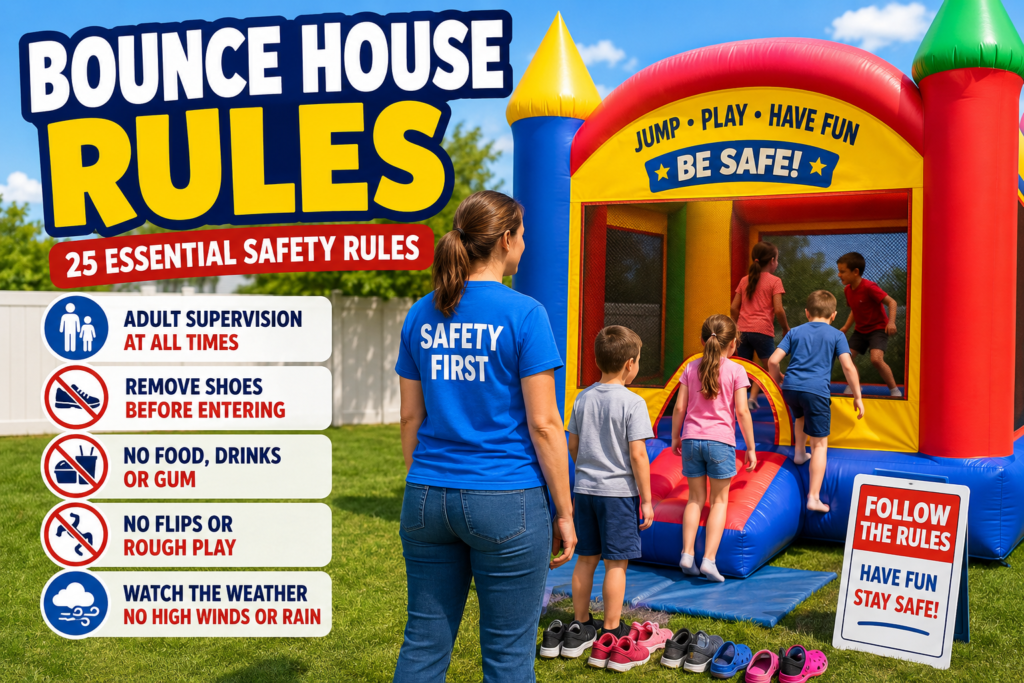
Why Bounce House Rules Matter
Bounce houses can turn a regular backyard party, school event, church event, or birthday celebration into something kids remember for years. They are fun, colorful, exciting, and easy to add to almost any event. But without clear bounce house rules, that fun can quickly turn into injuries, damaged equipment, upset parents, or liability problems.
The biggest mistake people make is thinking a bounce house can run itself. It cannot.
Most problems happen because of simple things that could have been prevented: too many kids inside, toddlers jumping with older kids, no adult watching, kids doing flips, poor anchoring, bad weather, shoes inside, or kids climbing the walls and netting.
That is why every party host, parent, school, church, and bounce house rental business needs a clear list of rules before the first child starts jumping.
This guide gives you 25 bounce house rules you can use for birthday parties, backyard events, rental businesses, school functions, church events, festivals, and family gatherings.
Quick Safety Zones: Bounce House Rules at a Glance
| Rule Category | Main Focus | Strictness | Risk If Ignored | Notes |
|---|---|---|---|---|
| Adult Supervision | Active watching | Critical | High | One adult should watch the inflatable at all times |
| Weather | Wind, rain, lightning | Critical | Severe | Shut it down if wind, storms, or lightning appear |
| Age Groups | Toddlers vs older kids | High | High | Never mix toddlers with big kids or teens |
| Shoes | Socks only | High | Medium | Shoes damage vinyl and can hurt other jumpers |
| Food & Drinks | No eating inside | High | High | Prevents choking, slipping, stains, and mess |
| Sharp Objects | Empty pockets | Critical | High | Keys, toys, jewelry, and phones can injure kids or damage vinyl |
| Blower Area | Electrical safety | Critical | High | Kids should stay away from cords, blower, and air tubes |
| Slides | Feet-first only | High | High | One rider at a time if the inflatable has a slide |
The Golden Rule Before You Inflate
Before anyone jumps, assign one adult as the bounce house gatekeeper.
This person should actively watch the entrance, control how many kids go inside, stop rough play, watch the weather, and make sure kids follow the rules.
Do not assume “someone is watching.” That is how accidents happen.
A good gatekeeper checks for:
- Too many kids inside
- Kids doing flips
- Rough play
- Kids climbing walls or netting
- Shoes, toys, or food inside
- Weather changes
- Soft spots or deflation
- Kids playing near the blower
- Toddlers mixing with older kids
If you only remember one rule, remember this: no adult supervision, no bounce house.
25 Essential Bounce House Rules
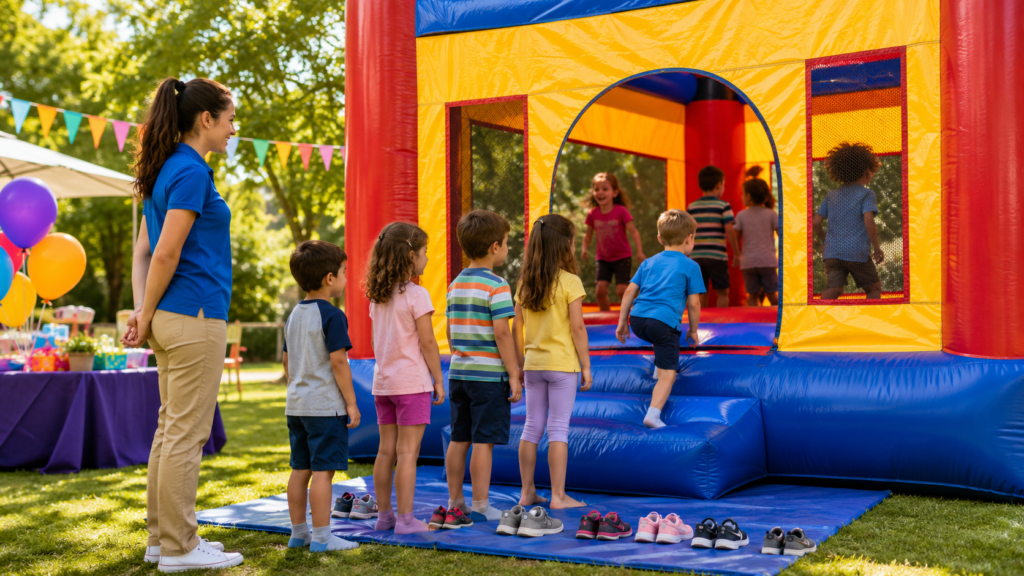
1. Adult Supervision Is Required at All Times
A bounce house should never be open without a responsible adult watching it. The adult should be close enough to stop unsafe behavior immediately.
They should not be inside the house, far away at a table, distracted on their phone, or assuming another parent has it covered.
The supervisor should control:
- Who enters
- How many kids enter
- When groups rotate
- When the inflatable needs to shut down
- When a child needs to take a break
This is the most important bounce house rule.
2. Group Kids by Age and Size
Never mix toddlers with older kids or teens. Bigger kids jump harder, fall harder, and can accidentally knock over smaller children.
A safe party setup is to separate kids into groups like:
- Toddlers: ages 2–4
- Younger kids: ages 5–7
- Older kids: ages 8–12
- Teens: only if the inflatable allows it
This rule prevents collisions and keeps smaller kids from getting hurt.
3. Follow the Maximum Occupancy Limit
Every inflatable has a limit for how many children can jump at one time. Do not guess. Follow the rental company’s or manufacturer’s limit.
Too many jumpers can lead to:
- Collisions
- Falls
- Overcrowding
- Rough play
- Deflation stress
- Damage to the inflatable
For a large party, use timed rotations instead of letting everyone rush inside at once.
4. Follow the Weight Limit
Weight limits matter just as much as headcount. A bounce house may be able to hold five small children but not five older kids or teens.
If you are renting the bounce house, ask for the weight limit before the event starts. If you own a rental business, make sure the weight limit is clearly written on the contract and posted near the inflatable.
5. Remove Shoes Before Entering
Shoes should never be worn inside the bounce house.
Shoes can:
- Tear the vinyl
- Track in dirt and mud
- Hurt other kids
- Damage seams
- Make the inflatable harder to clean
Socks are usually the best option because bare feet can sometimes rub against the vinyl and cause friction burns.
6. Empty Pockets Before Jumping
Before kids enter, they should empty their pockets.
No:
- Phones
- Keys
- Coins
- Toys
- Candy
- Pens
- Pencils
- Rocks
- Small objects
Items can fall out, get lost, poke someone, or damage the inflatable.
7. No Sharp Objects Inside
Sharp objects should stay far away from the bounce house.
Do not allow:
- Belt buckles
- Pointed jewelry
- Hair clips with sharp edges
- Glasses if they can safely be removed
- Toy swords
- Sticks
- Pens
- Keys
A small puncture can turn into a bigger tear fast.
8. No Food, Drinks, Candy, or Gum
Food and jumping do not mix.
No food, drinks, gum, candy, or snacks should be allowed inside the bounce house.
This rule prevents:
- Choking
- Slipping
- Sticky messes
- Stains
- Ants and bugs
- Cleaning problems
- Damage fees from rental companies
Keep snacks at the tables and let kids eat during break time.
9. No Flips, Somersaults, or Cartwheels
Flips look fun, but they are one of the most dangerous things kids can do in a bounce house.
Ban:
- Front flips
- Backflips
- Somersaults
- Cartwheels
- Wrestling moves
- Jumping into other kids
A bad landing can injure a child’s neck, back, head, arm, or leg.
10. No Rough Play
No pushing, tackling, wrestling, kicking, body-slamming, dogpiling, or crashing into other kids.
A bounce house is not a wrestling ring. Rough play is one of the fastest ways a fun party turns into tears.
The adult supervisor should stop rough play immediately.
11. Do Not Climb the Walls or Netting
The walls and netting are there for safety and airflow. They are not made for climbing.
Kids should not:
- Climb the side walls
- Hang from the netting
- Jump against the walls
- Try to climb over the top
- Sit on entrance barriers
The rule is simple: bounce on the floor only.
12. Keep the Entrance and Exit Clear
The entrance ramp is for getting in and out only.
Kids should not:
- Sit on the entrance
- Block the doorway
- Jump on the ramp
- Wrestle near the entrance
- Push others while entering
A clear entrance helps kids exit quickly if the inflatable starts losing air or weather changes.
13. Exit Immediately If the Bounce House Starts Deflating
If the bounce house feels soft, starts sagging, or loses shape, everyone should exit right away.
Possible causes include:
- Blower unplugged
- Power outage
- Loose air tube
- Tear in the inflatable
- Overcrowding
- Blower problem
Do not let kids keep jumping in a partially deflated bounce house.
14. Keep Kids Away From the Blower
The blower keeps the bounce house inflated. Kids should never touch it, sit near it, unplug it, or play with the cords.
The blower area should be off-limits because it includes:
- Electrical cords
- Moving air equipment
- Air tubes
- Tripping hazards
- Possible water/electricity danger
For rental businesses, cone off or clearly mark the blower area.
15. Use the Right Power Setup
Bounce house blowers need a safe power source.
Avoid:
- Damaged cords
- Wet cords
- Loose plugs
- Overloaded outlets
- Multiple blowers on weak circuits
- Extension cords that are too long or too light-duty
If using a generator, make sure it can handle the blower’s power needs.
16. Anchor the Bounce House Properly
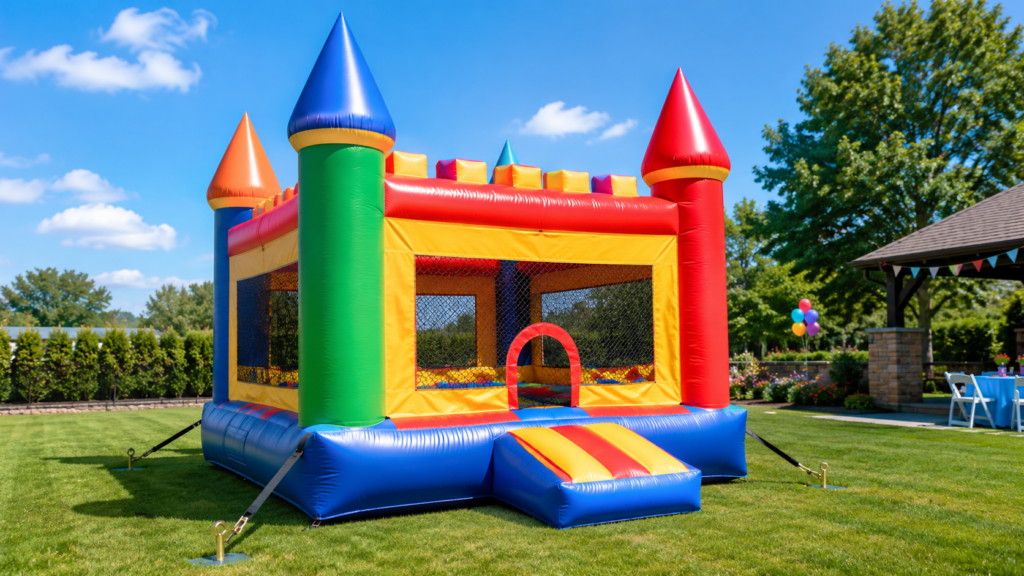
Outdoor bounce houses must be secured before use.
Depending on the surface, this may require:
- Ground stakes
- Sandbags
- Water weights
- Concrete weights
- Manufacturer-approved anchors
Never operate an outdoor bounce house that is not anchored.
17. Shut It Down During High Wind
Wind is one of the biggest bounce house dangers. Even if the weather looks fine, gusts can become dangerous quickly.
If wind picks up, stop the jumping and get everyone out. Do not wait until the inflatable starts moving.
A simple rule for party hosts: if you are questioning the wind, shut it down.
Inflatables can easily become airborne in sudden gusts, which is why the U.S. Consumer Product Safety Commission strongly advises anchoring them securely and evacuating immediately if winds approach 15 mph.
18. Do Not Use During Rain, Thunder, or Lightning
Rain makes the inflatable slippery. Lightning is dangerous. Storms can bring sudden wind.
Stop use immediately if you notice:
- Heavy rain
- Thunder
- Lightning
- Strong wind
- Storm warnings
- Sudden gusts
Wait until the weather is fully safe before reopening.
19. Set Up on Flat, Even Ground
The bounce house should be placed on a flat, level surface.
Good setup areas include:
- Flat grass
- Smooth indoor gym floors
- Clean pavement with proper weights
- Level event spaces
Avoid:
- Hills
- Rocks
- Mud
- Sharp landscaping
- Uneven ground
- Concrete edges
- Driveways near traffic
Flat ground makes the inflatable more stable and safer.
20. Keep the Bounce House Away From Hazards
Do not set up near:
- Power lines
- Trees
- Fences
- Pools
- Fire pits
- Roads
- Sharp objects
- Sprinklers
- Grills
- Construction areas
Leave open space around the inflatable so kids can enter, exit, and move safely.
21. No Pets Allowed
Pets should stay out of the bounce house.
Dogs and cats can:
- Scratch the vinyl
- Puncture the material
- Scare kids
- Get injured
- Cause tripping
- Leave hair or mess behind
Even friendly pets should stay outside the inflatable area.
22. No Silly String, Face Paint, Glitter, or Confetti
Silly string, face paint, slime, glitter, confetti, markers, and messy makeup should not go inside the bounce house.
These items can:
- Stain the vinyl
- Create cleaning fees
- Damage the inflatable
- Make the surface slippery
- Stick to seams and netting
For rental businesses, this should be written directly in the rental agreement.
23. Use Slide Rules If the Bounce House Has a Slide
If the inflatable has a slide, add extra rules.
Slide rules:
- Slide feet-first only
- One child at a time
- No head-first sliding
- No climbing up the slide
- Wait until the landing area is clear
- No jumping from the top
- No sitting at the bottom of the slide
Slides are fun, but they need clear control.
24. Use Time Slots for Large Crowds
If you have a big party, do not let every kid rush in at once.
Use 5-minute or 10-minute rotations. This keeps the bounce house from getting overcrowded and gives every child a fair turn.
A smart system is to rotate by:
- Age
- Height
- Wristband color
- Party group
- Numbered turns
For example, toddlers jump first, then ages 5–7, then ages 8–12.
25. Sick, Injured, or Overheated Kids Should Sit Out
Kids should not jump if they are sick, dizzy, overheated, injured, wearing a cast, or recovering from an injury.
Watch for signs like:
- Dizziness
- Crying
- Limping
- Heavy sweating
- Red face
- Headache
- Nausea
- Fatigue
In hot weather, give kids water breaks and rest time.
Bounce House Rules by Age Group
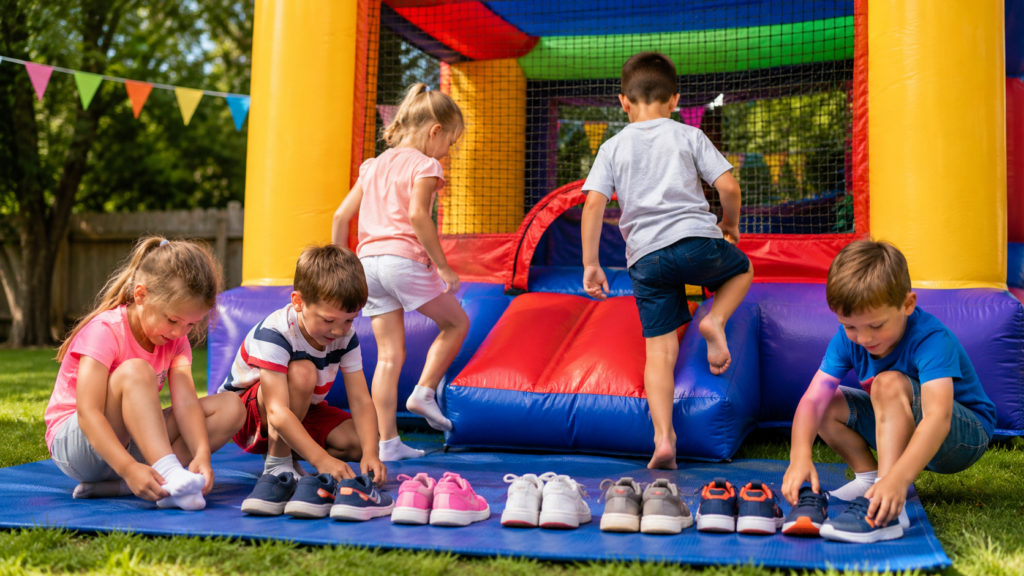
Bounce House Rules for Toddlers Ages 2–4
Toddlers need extra protection because they are smaller, less coordinated, and more likely to fall.
Toddler rules:
- Keep toddlers separate from older kids
- Use a toddler-friendly inflatable if possible
- Keep the group small
- Have an adult watching closely
- No rough bouncing
- No climbing
- Short jump sessions only
- Stop if a toddler looks scared or tired
Best setup: a low-profile toddler inflatable with soft play boundaries.
Bounce House Rules for Kids Ages 5–10
This is the most common bounce house age group. Kids this age usually have the most energy, so supervision matters.
Rules for this group:
- No flips
- No rough play
- No climbing walls
- No sitting at the entrance
- Rotate groups if crowded
- Keep similar-sized kids together
This age group is fun, but they need quick correction before excitement turns into chaos.
Bounce House Rules for Teens
Teens can hit the weight limit fast. They also jump harder and may be more likely to roughhouse.
Teen rules:
- Check the weight limit first
- Limit how many teens enter at once
- No wrestling
- No flips
- No jumping into each other
- No bouncing if the inflatable is made for small children only
Some bounce houses are not designed for teens or adults.
Printable Bounce House Rules Sign
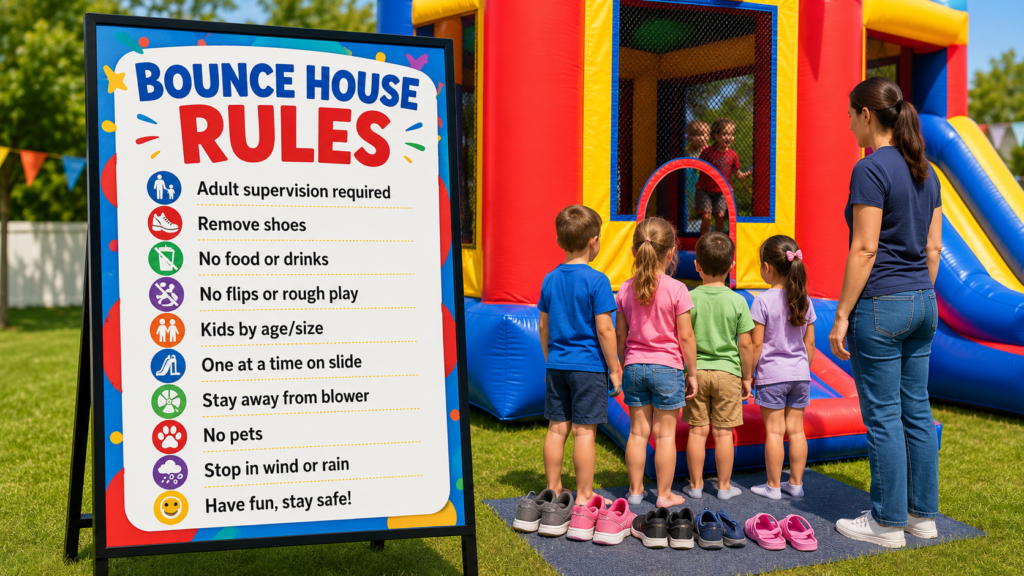
Copy and paste this section into Canva, WordPress, or a printable flyer.
Bounce House Rules
- Adult supervision required at all times.
- Remove shoes before entering.
- Socks are recommended.
- No food, drinks, candy, or gum.
- Empty pockets before jumping.
- No phones, keys, toys, or sharp objects.
- No flips, cartwheels, or somersaults.
- No wrestling, pushing, tackling, or rough play.
- Do not climb walls, nets, or slides.
- Keep the entrance and exit clear.
- Kids must be grouped by age and size.
- Follow the maximum number of jumpers.
- Follow the weight limit.
- Slide feet-first only.
- One person down the slide at a time.
- Stay away from the blower and cords.
- No pets allowed.
- No silly string, glitter, slime, or face paint.
- Stop jumping if the inflatable loses air.
- Do not use during wind, rain, thunder, or lightning.
- Take breaks in hot weather.
- Sick or injured kids should sit out.
- Listen to the adult supervisor.
- Break the rules and you may be asked to leave.
- Have fun and stay safe.
Bounce House Rules for Rental Businesses
If you own a bounce house rental business, rules protect more than the children. They protect your equipment, your business, your reputation, and your income. Setting clear boundaries not only keeps the kids safe but also protects your business from costly liabilities; if you are looking for more ways to scale your event company, explore our full strategic guides over at Hustle Setup.
Every rental business should provide:
- Written safety rules
- Setup instructions
- Weather policy
- Cleaning policy
- Damage policy
- Weight limits
- Occupancy limits
- Emergency contact number
- Delivery and pickup instructions
- Signed rental agreement
- Clear cancellation policy
- Customer responsibility checklist
What to Put in Your Rental Agreement
Your bounce house rental agreement should include rules about:
- Adult supervision
- No shoes
- No food or drinks
- No silly string
- No face paint
- No pets
- No water on dry inflatables
- Weather shutdown rules
- Damage fees
- Cleaning fees
- Late pickup access
- Electrical requirements
- Customer responsibility for safe use
This helps customers understand the rules before the event begins.
Bounce House Rules for Birthday Parties
Birthday parties get wild because kids are excited. The best way to control the chaos is to explain the rules before anyone jumps.
Use this party system:
- Set up a rules sign near the entrance.
- Put shoes in a bin or on a mat.
- Let toddlers jump separately.
- Rotate older kids in groups.
- Keep one adult near the entrance.
- Use a timer for large groups.
- Stop rough play fast.
- Shut it down if the weather changes.
This keeps the party fun without letting it get out of control.
Common Bounce House Mistakes to Avoid
Mistake 1: Letting Too Many Kids Inside
Overcrowding is one of the most common reasons kids crash into each other. Use rotations instead.
Mistake 2: No Adult Watching
A bounce house without supervision is a problem waiting to happen.
Mistake 3: Ignoring the Weather
Wind, rain, thunder, and lightning should be taken seriously.
Mistake 4: Mixing Toddlers With Big Kids
Small kids can get hurt fast when bigger kids jump near them.
Mistake 5: Letting Kids Flip
Flips are not worth the risk. Ban them completely.
Mistake 6: Allowing Food Inside
Food can cause choking, stains, and slippery messes.
Mistake 7: Forgetting About the Blower
The blower must stay connected, protected, and off-limits to kids.
Pro Tips for Event Hosts
Use a Visual Rules Sign
Kids may not read a long list. Use icons if possible:
- Shoe with a red X
- Food with a red X
- No flips symbol
- Adult supervisor icon
- Wind warning icon
Use Wristbands for Age Groups
Give toddlers one color, younger kids another color, and older kids another color. This makes rotations easier.
Use a Timer
For big parties, set a timer for each group. Five to ten minutes per group usually works well.
Keep Water Nearby
Kids get hot fast when jumping. Have water bottles or a drink station nearby.
Keep a First-Aid Kit Close
Have basic first-aid supplies available in case of small scrapes, bumps, or minor accidents.
FAQs About Bounce House Rules
What are the most important bounce house rules?
The most important bounce house rules are adult supervision, proper anchoring, no use during bad weather, no shoes, no food or drinks, no flips, no rough play, and separating kids by age and size.
How many kids can be in a bounce house at once?
It depends on the size and weight limit of the inflatable. Always follow the manufacturer’s or rental company’s limit. If you are not sure, ask before the event starts.
Can adults go in a bounce house?
Only if the inflatable is rated for adults. Many bounce houses are designed for children only. Adults can exceed the weight limit and damage the inflatable or increase the risk of injury.
Should kids wear socks in a bounce house?
Yes, socks are usually best. Shoes should be removed, and bare feet can sometimes rub against the vinyl. Socks help reduce friction.
Can kids eat inside a bounce house?
No. Food, drinks, candy, and gum should stay outside the bounce house because they can cause choking, slipping, stains, and cleaning issues.
Are bounce houses safe for toddlers?
Bounce houses can be safer for toddlers when they use a toddler-friendly inflatable, jump in a small group, stay away from older kids, and have close adult supervision.
What should I do if the bounce house starts losing air?
Get everyone out immediately. Check the blower, power cord, air tube, and inflatable. Do not allow kids back inside until the problem is fixed.
Can you use a bounce house in the rain?
A dry bounce house should not be used in rain unless the manufacturer or rental company says it is designed for that use. Rain can make the vinyl slippery and unsafe.
Can you put water on a regular bounce house?
No. Do not add water to a dry bounce house unless it is specifically made to be used as a water inflatable. Water can make it slippery and dangerous.
What is the best way to control a large bounce house party?
Use age groups, wristbands, time slots, and one adult gatekeeper. Do not let all the kids jump at once.
Final Thoughts: Safe Rules Make the Party Better
Bounce houses are supposed to be fun, not stressful. The easiest way to keep the party safe is to set rules before anyone jumps.
The best bounce house rules are simple: have adult supervision, group kids by size, remove shoes, ban flips, keep food out, anchor the inflatable, watch the weather, and shut it down when rules are not being followed.
For parents, these rules protect the kids. For rental businesses, they protect your equipment and reputation. For event hosts, they keep the party organized and fun.
A safe bounce house party is a better bounce house party.